

STEM Sparks April 2026

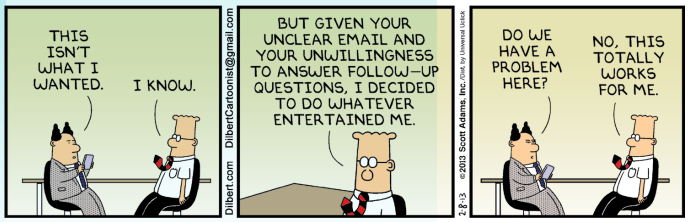
This topic addresses a persistent problem in technology and engineering education (TEE): miscommunication between teachers and students during open‑ended design challenges. The authors argue that while design-based learning is central to TEE—and valued for its creativity, problem-solving, and real-world relevance—it is also inherently messy and ill-defined. These characteristics often lead to students misunderstanding expectations, resulting in work that misses the instructional goals despite significant effort. Teachers, pressed for time, frequently respond the way the Dilbert cartoon humorously depicts: moving on rather than repairing the communication breakdown.
The article situates this issue within the broader context of the Standards for Technological and Engineering Literacy (STEL), which positions design as a core practice encompassing creativity, systems thinking, collaboration, ethics, and communication. While experienced teachers can often recognize strong design work when they see it, students lack that internal benchmark. Many struggle to determine what matters most—documentation versus function, innovation versus reliability, risk-taking versus safety—leading to uncertainty, reduced confidence, and in some cases disengagement. The authors frame this problem through a series of guiding questions, including how teachers can better communicate expectations, foster student self-efficacy, and help students evaluate their own work during the design process.
To address these challenges, the authors introduce Learning by Evaluating (LbE), a design-learning primer rooted in research on adaptive comparative judgment (ACJ). ACJ is an assessment approach based on the principle that people make more reliable judgments when comparing two artifacts than when scoring work against abstract rubrics. Borrowing from this idea, LbE places structured evaluation activities at the beginning of a design challenge rather than at the end. Students are asked to compare pairs of previously completed design artifacts and decide which is better based on a guiding criterion, then justify their reasoning. Through research and classroom trials, the authors observed that this comparative process influences how students think about quality, design language, and expectations before they begin designing themselves.
The authors identify four key benefits of using LbE as a pre-design learning activity:
- Students gain exposure to prior work, helping them understand what “good” looks like.
- Students identify strengths and weaknesses they can apply (or avoid) in their own designs.
- Students learn the professional language of design by articulating their judgments.
- Students deepen conceptual understanding by explaining their reasoning.
Supported by an NSF-funded study involving high school students in Georgia, the article outlines a three-step instructional approach for implementing LbE:
- Introducing and orienting students, including asking reflective questions and modeling simple comparisons.
- Engaging students in a series of structured comparisons, guided by holistic criteria such as safety, usability, attractiveness, or community fit.
- Leading a classroom debrief, where students and teachers discuss insights, surface differing values, and align on design priorities and constraints.
The article also provides practical guidance for implementation, highlighting three tools—Google Slides, No More Marking, and RM Compare—that vary in sophistication, analytics, and setup requirements. These tools allow teachers to scale the comparison process while capturing student reasoning and areas of consensus or disagreement.
In conclusion, the authors acknowledge challenges, including the time required to curate effective comparison artifacts and the risk that students may copy rather than synthesize ideas. However, they argue that with intentional facilitation, LbE helps teachers and students converge on shared expectations while also supporting divergent thinking and creativity. Ultimately, Learning by Evaluating offers a practical strategy for avoiding “Dilbert-style” miscommunication and improving the quality of design-based learning experiences.
Lessons from Dilbert: Clarifying Design Expectations was authored by Scott R. Bartholomew, Nathan Mentzer, and Andrew Jackson and appeared in the September 2023 issue of Technology and Engineering Education.