
STEM Sparks May 2026
Many STEM programs launch with excitement. Students are engaged. Teachers are energized. Early results look promising. Then comes the inevitable question:
“How do we scale this?”
For too many districts, that question marks the beginning of a stall. Programs that thrive as pilots struggle to grow beyond a handful of classrooms or a single school. The issue isn’t the quality of the curriculum—it’s what happens after early success.
At the ITEEA Virginia Beach Conference, Dr. Natoshia Anderson, CEO of The Anderson Strategy Group, tackled this challenge head-on in her session Crack the Code: Scale Your STEM Program Now. Her central message was clear: scaling is not an extension of launching—it’s an entirely different skill set.
The “Pilot Problem”
Across the country, STEM initiatives often follow the same pattern:
- A successful launch serving 100–200 students
- High engagement and positive feedback
- Growing interest from leadership and community partners
- Then… a plateau
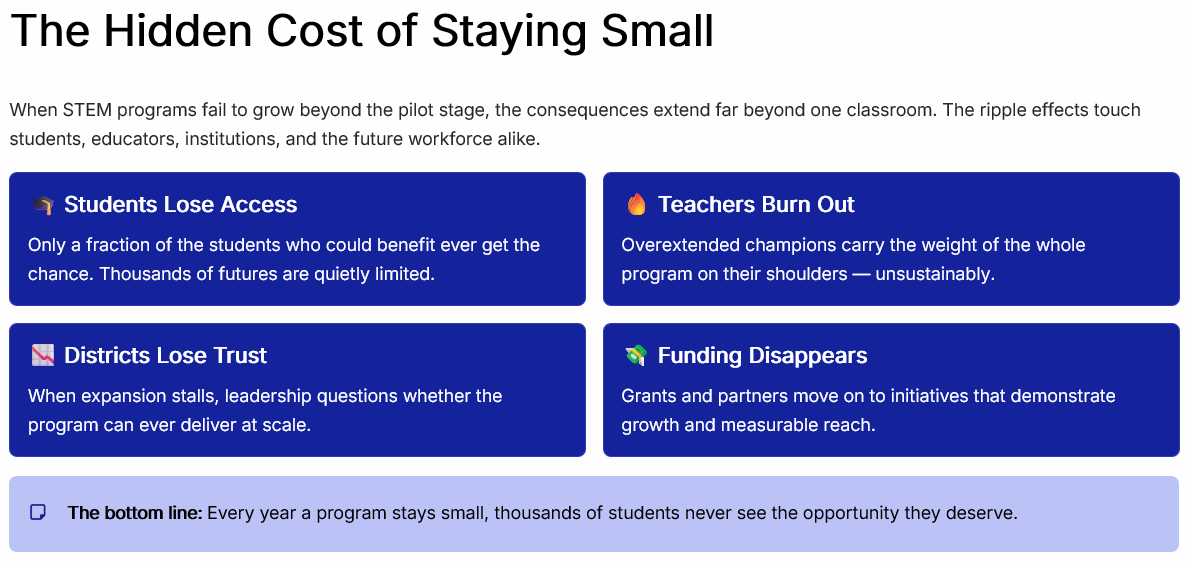
When scaling stalls, the consequences ripple outward. Students lose access. District leaders lose confidence. Opportunities that could reach thousands remain limited to a few.
The good news? Programs that scale successfully are not relying on luck. They are built on intentional systems.
Introducing the SCALE Framework
Dr. Anderson introduced the SCALE Framework, a structure shared by STEM programs that grow without sacrificing quality. Each letter represents a critical system that must work in concert. Miss one, and the entire effort is at risk.
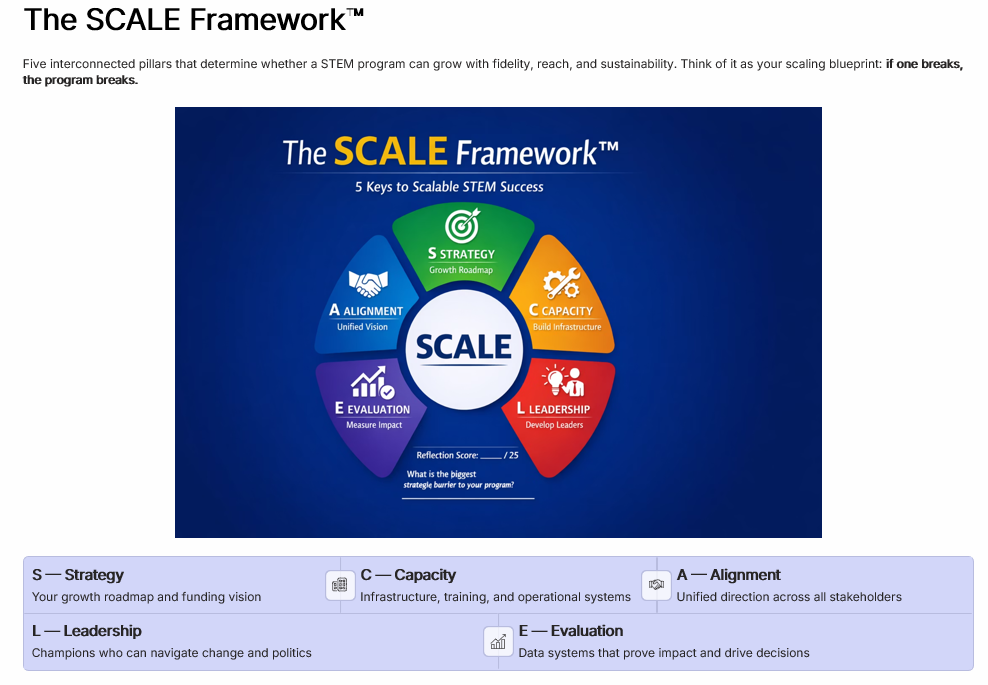
S — Strategy
Successful scaling starts with clarity. Programs need a defined growth roadmap—not just a vision, but milestones, funding pathways, and outcomes that matter. Scaling without strategy, Dr. Anderson noted, is simply hoping for more.
Ask yourself:
- Do we know what “growth” looks like in year one, three, or five?
- Is funding diversified, or dependent on a single grant?
- Can we clearly articulate our intended student impact?
C — Capacity
Growth requires infrastructure. That means:
- Sustainable teacher training systems
- Support structures that don’t rely on heroic effort
- Partnerships that evolve as the program expands
Capacity-building ensures your program can grow without breaking.
A — Alignment
Even the strongest STEM initiative will struggle if stakeholders aren’t aligned. District leaders, teachers, and industry partners must share a common understanding of:
- Why the program matters
- What role each partner plays
- How success is measured
When alignment is present, STEM expansion becomes a strategic priority—not a side project.
L — Leadership
Leadership is often the most overlooked scaling factor. Scaling STEM programs requires leaders who can:
- Navigate complex partnerships
- Manage organizational change
- Make strategic decisions amid uncertainty
Strong leadership turns momentum into permanence.
E — Evaluation
Finally, data drives growth. Programs that scale successfully track more than participation—they measure equity, fidelity, retention, and outcomes at scale. These data systems build trust, inform decisions, and prove impact beyond the pilot phase.
What Scaling Can Look Like
Dr. Anderson shared a real-world example of a district that grew a STEM initiative from 150 students to more than 3,000—without losing the qualities that made it successful. The key wasn’t more staff or more grants; it was the deliberate application of all five SCALE elements working together.
A Spark for Reflection
As you think about your own STEM program, consider this quick reflection:
- Where are you strongest across the SCALE framework?
- Where are the gaps?
- What is one concrete action you could take in the next 90 days to move toward sustainable growth?
Every year a strong program stays small, thousands of students miss an opportunity they deserve.
The takeaway: Great STEM curriculum is the starting point—but systems, leadership, and strategy are what turn great ideas into lasting impact.
This STEM Sparks article was inspired by Dr. Natoshia Anderon's presentation of the same name at ITEEA's 2026 Conference in Virginia Beach.