
STEM Sparks February 2026
From Gardens to Data: How Interdisciplinary Sustainability
Work Is Transforming Technology and Engineering Education
Just outside Washington, D.C., Falls Church City Public Schools (FCCPS) has spent the past several years quietly building something remarkable: a sustainability program that is as much an educational philosophy as it is a collection of projects. Spread across indoor vivariums, campus gardens, rainwater systems, and student‑designed recycling labs, the district has created a network of “living environments” where learners can investigate complex systems, design solutions, and study the impact of their work in real time. For Technology and Engineering (T&E) educators, this initiative demonstrates what happens when sustainability is not an elective or add‑on, but the organizing principle that invites transdisciplinary collaboration, student agency, and authentic, place‑based problem‑solving. “New forms of technology demand critical thinking, invention, and adaptability,” says technology and engineering educator Dr. Ray Wu-Rorrer. “Interdisciplinary sustainability gives students the robust experiences they need to address the complex issues of today and tomorrow.”
A Sustainability Framework Built for Real‑World Learning
FCCPS is a comprehensive International Baccalaureate (IB) school division, serving a diverse and transient student population—15 to 20 percent of students move in or out each year. That mobility has shaped a system that emphasizes inquiry, project‑based learning, and transferable skills. Sustainability emerged as a unifying theme that could anchor those goals across grade levels and disciplines. In 2019, district stakeholders developed the AgroLab model, a framework connecting environmental science, energy systems, design, and urban agriculture into a single cross‑disciplinary ecosystem. The goal was simple but ambitious: create learning environments that mirror the complexity of real-world challenges, where T&E students can test ideas, manipulate variables, and see outcomes unfold in authentic contexts.
Today, that framework touches everything—from the crops grown in hydroponic beds to the data streaming from air pollution sensors to the cafeteria waste redirected into composting systems.
Where Students Learn by Touching the System Itself
Across the district, indoor and outdoor spaces have been intentionally developed as laboratories for integrative STEM. The vivarium and aquatic education facility provide controlled climates for propagation and environmental studies. School gardens, including native pollinator beds and food-production plots, serve as an entry point for engineering, ecology, and data collection. Last year, students donated almost 200 pounds of produce from these gardens and an indoor hydroponics system to local food banks. At select sites, sensors also monitor air particulates—creating multi-year datasets for students to analyze across science, engineering, and computer science courses. Each of these environments supports the UN Sustainable Development Goals (SDGs), reinforcing global frameworks while keeping learning deeply local and hands‑on.
Projects That Bring Design, Data, and Sustainability Together
What makes the FCCPS program distinctive is the sheer variety of student experiences—and how naturally they weave together design, fabrication, scientific inquiry, and community impact.
Native Pollinator & Urban Farm Gardens
With guidance from local landscape professionals, students select native species, manage planting cycles, collect ecological data, and track harvest yields. The work strengthens systems thinking while directly supporting community food access.
FarmBot: Iteration in Plain Sight
A grant-funded effort to automate a garden plot using the FarmBot system became a multi‑year engineering case study. The system was moved, rebuilt, and redesigned repeatedly as facilities evolved—until students successfully grew their first fully automated crop this spring. The project embodies the engineering design cycle more authentically than any worksheet ever could.
Circular Economy Design
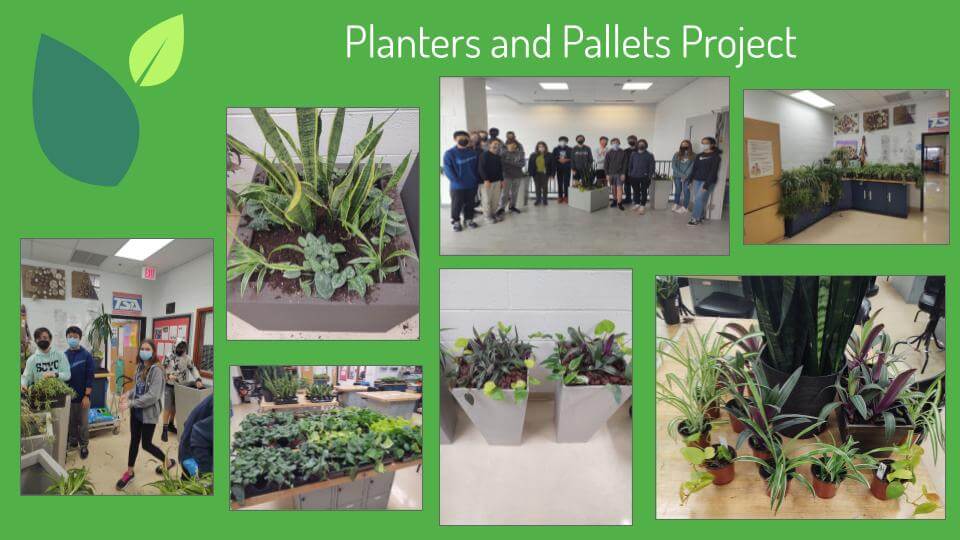
A small project using discarded pallets grew into a district-wide exploration of materials flow. Students now build planters from recycled plastic bags, prototype with reclaimed wood—including hardwood flooring salvaged from a gym reinstallation—and explore life‑cycle analysis and sustainable material sourcing in their design courses.
CAD and Flat‑Pack Thinking
To teach modeling and technical drawing, students reverse‑engineer and design flat‑pack objects, exploring manufacturability, transport efficiency, and user-assembly considerations. The challenge reframes CAD not as software practice, but as systems thinking.
Social‑Distancing Courtyard
During COVID, students collaborated virtually with municipal zoning and permitting officials to design a physically distanced courtyard for the new high school. Using at‑home materials like balsa and foam core, they learned scale modeling, stakeholder communication, and urban planning—all through a real challenge affecting their community.
Precious Plastic–Inspired Mobile Recycling Lab
One of the district’s most innovative endeavors is a student‑built mobile recycling center equipped with a shredder, arbor press, and custom molds. Feedstock includes 3D‑printing scrap, cafeteria polypropylene trays, yogurt cups, and more. Students shred, melt, and remold plastics into new products—closing material loops that previously ended in landfills.
Composting, Expanded
What began as small vermicomposting bins grew into a division-wide composting program. A partner organization processes organic waste from school kitchens, while student teams track quantity and composition through sensor systems. The initiative is pushing the district toward a zero‑waste cafeteria model.
A K-12 Progression Rooted in Inquiry and Impact
Sustainability and engineering literacy begin early in FCCPS.
- Elementary students use the SDGs to guide their Grade 5 Exhibition projects, designing solutions for authentic community needs.
- Middle school learners build nesting structures for bats, bees, and even flying squirrels—selecting materials, documenting data, and partnering with external organizations for placement and monitoring.
- High school students take on increasingly complex challenges, from multi-year rain garden data analysis to plastics recycling, composting logistics, FarmBot design, and advanced CAD-to-fabrication projects.
Across each stage, sustainability is not a topic but a lens—the connective tissue linking design, science, engineering, and community service.
What T&E Educators Can Borrow—Starting Now
Even without a vivarium or a network of gardens, the principles behind FCCPS’s success are widely replicable:
- Start by mapping your assets. Identify underused spaces or material flows that can host a pilot project.
- Recruit allies early. Food services, facilities, art, and local partners can turn small ideas into robust systems.
- Tie projects to standards and SDGs. A few well-chosen standards give structure; SDGs give purpose.
- Celebrate visible wins. A sensor‑equipped rain barrel or a reclaimed-material planter can build momentum.
- Expect and embrace iteration. Rebuilds aren’t setbacks—they’re evidence of real engineering.
- “Close a loop.” Choose one waste stream and design a process to reduce, repurpose, or measure it.
- Share the story. Publish data, display student work, donate produce, and invite the community in.
Authentic Assessment Opportunities
The work naturally lends itself to meaningful assessment:
- Design briefs with decision logs documenting tradeoffs.
- Data‑storytelling presentations linking environmental data to recommendations.
- Lifecycle analyses of materials used in student projects.
- Impact memos written for real stakeholders—food services, facilities, or community partners.
Learn More and Get Connected
- Watch the video presentation
- Explore the STEM Environments document
- Connect with the team: Ray Wu Rorrer and Dr. Mecca welcome conversation, collaboration, and school visits. [wurorrer@gwmail.gwu.edu]
“Many of these projects have been years in the making,” the FCCPS sustainability team notes. “We’re happy to share resources, lessons learned, and even host visitors.”
Be on the lookout in the coming months for our team's Technology and Engineering Education article "Cultivating Citizenship: The Pedagogical and Community Impact of Urban Agriculture." The case study highlights the importance of partnerships with local nonprofits and their impact on student-led groups within the community.
By Dr. Ray Wu-Rorrer and Dr. Peter Mecca, with collaborators from Falls Church City Public Schools
(Adapted for ITEEA members)