

STEM Sparks January 2026

Turning Failure Into Fuel: How Self-Reflection Shapes Design Success
What really happens when beginning designers face failure? Andrew Jackson’s article, “Does that mean it’s a success?”: Beginning Designers’ Forethought and Self-Reflection in Engineering Design Thinking (Journal of Technology Education, Spring 2025), dives deep into the mindset and strategies of high school students tackling an iterative soft robotics challenge. Through think-aloud protocols, design artifacts, and interviews, Jackson reveals how forethought and self-reflection—two critical phases of self-regulation—shape students’ ability to persist, adapt, and learn from setbacks.
The study uncovers striking contrasts: some teams embrace iteration and view failure as a stepping stone, while others fixate on early ideas and rationalize partial success to avoid further effort. These behaviors highlight the powerful interplay between planning, evaluation, and decision-making in design thinking. Jackson argues that teaching students not just what to do but what to think during design can transform frustration into productive learning moments.
What are some of the ways that educators can help students develop stronger design thinking and self-regulation skills?
1. Emphasize Planning Before Building
- Encourage students to set clear short-term and long-term goals before starting a design task.
- Use prompts like: “What will success look like for this step?” or “What’s your plan if this doesn’t work?” to foster forethought.
2. Normalize Failure as Part of Learning
- Frame failure as data, not defeat. Remind students that each unsuccessful attempt provides insight for improvement.
- Share examples of professional designers iterating multiple times to reinforce this mindset.
3. Scaffold Reflection at Key Moments
- Build in structured reflection checkpoints after each prototype or test.
- Ask guiding questions: “What worked? What didn’t? Why?” and “What will you change next time?”
4. Leverage Documentation for Decision-Making
- Teach students to actively use their design notebooks—not just record steps, but revisit notes to inform next iterations.
- Incorporate quick reflection prompts in notebooks like: “What did we learn from this attempt?”
5. Encourage Iteration with Purpose
- Push students to vary design ideas strategically, not just repeat the same approach.
- Suggest experimenting with one variable at a time to understand cause-and-effect relationships.
6. Provide Authentic Context and Materials
- Use real-world challenges and tangible resources to help students visualize goals and connect design decisions to practical outcomes.
- Authentic tasks increase motivation and make reflection more meaningful.
7. Model Self-Regulation Language
- Demonstrate phrases like: “Let’s plan our next step” or “What does this result tell us?” so students internalize proactive thinking.
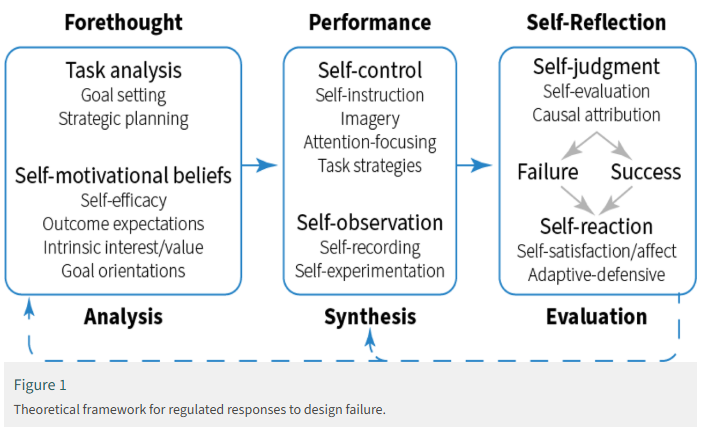
For educators and researchers, this article offers practical insights and a framework for integrating self-regulation into design education. It shows why reflection and proactive goal-setting are essential for cultivating resilient, informed designers—and how authentic, iterative challenges can unlock these skills. If you want to understand how students learn through failure and how to guide them toward deeper design expertise, this is a must-read.