
STEM Sparks March 2026
Educators face enormous pressure as they work to close widening achievement gaps. Students in high‑poverty areas have been most affected, amplifying the urgent need for low‑cost, high‑impact learning resources. To support teachers and families, EiE® (Engineering is Elementary) and the Museum of Science, Boston, created the EiE Families® program—a set of free, research‑based STEM activities accessible to children ages 4–11 and their caregivers.
Research strongly supports the benefits of family learning, noting that when parents engage in their children’s education, students show greater confidence, higher attendance, and improved graduation outcomes. These out‑of‑school learning experiences also relieve pressure on teachers by reinforcing academic content beyond the classroom. However, the authors stress that such activities must be engaging, culturally accessible, and easy to use if they are to reach a broad range of families.
The EiE Families program draws on EiE’s established instructional approach, which previously demonstrated significant success in improving elementary students’ understanding of engineering. Each activity begins with an illustrated comic that introduces a real‑world problem and guides children through an engineering or computer science design challenge using simple materials found at home. The comics feature diverse characters illustrated by artists from the represented cultures, helping ensure meaningful and authentic representation.
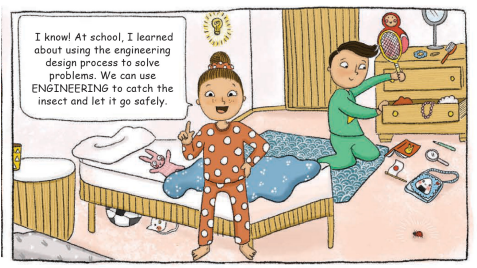
One example, Bye Bye Bug, follows siblings Kenji and Emi as they design a humane way to remove a ladybug from their room. Instead of giving families a prescribed solution, the activity invites them to brainstorm, design, test, and improve their own inventions. This open‑ended, choice-driven structure fosters creativity, self-efficacy, and a healthier view of failure—reflecting research showing that autonomy increases engagement and perseverance.
A 2021 evaluation of two EiE Families activities involved 75 participating families across 30 states. Results showed increases in both children’s and caregivers’ understanding of engineering, as well as confidence in discussing STEM topics. Many families tried more than one activity, and many reported that the experience sparked further curiosity and a desire to continue learning together. While the findings are preliminary, they suggest that programs like EiE Families can help re-engage students academically and serve as valuable tools for teachers working to counter learning loss.
Key Takeaways for Elementary Educators
1. Family engagement can extend classroom learning without adding to your workload.
These activities allow families to reinforce engineering and problem-solving skills at home, easing pressure on teachers who face limited instructional time.
2. Open-ended design challenges build student confidence and creativity.
Because the activities avoid “right answers,” students practice thinking independently—an essential skill in STEM and beyond.
3. Culturally responsive materials boost connection and engagement.
The program’s diverse, authentically illustrated characters help more students see themselves in STEM, supporting equity and inclusion goals.
4. Free, low‑material STEM activities remove barriers for families.
With no kits or purchases required, these resources are accessible to households across income levels—especially important in under-resourced communities.
5. Family STEM learning strengthens home–school relationships.
When caregivers develop confidence discussing STEM, they become more active partners in their child’s academic growth, which research consistently links to improved outcomes.