
STEM Sparks November 2026
Float Your Boat!
Wondering how to make STEM concepts both meaningful and memorable for elementary learners? Miette Brown's "Float Your Boat!" lesson demonstrates how educators can seamlessly combine the 5E Instructional Model with the Engineering Design Process (EDP) through an engaging design challenge focused on buoyancy, density, and displacement.
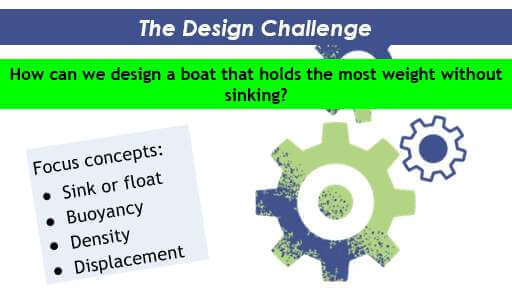
At the heart of the lesson is a simple but powerful challenge: How can students design a boat from aluminum foil that holds the most weight without sinking? Through investigation, discussion, design, testing, and redesign, students experience science and engineering as connected disciplines rather than separate subjects.
The Power of 5E + EDP
The lesson begins with the 5E Model, which guides students through a structured learning experience:
- Engage by sparking curiosity about why some objects float and others sink.
- Explore through hands-on experimentation with aluminum foil and water.
- Explain observations using scientific vocabulary such as buoyancy and density.
- Elaborate by applying new knowledge to boat design.
- Evaluate understanding through reflection and vocabulary connections.
Students then transition into the Engineering Design Process, where they identify the problem, brainstorm solutions, develop plans, build prototypes, test their designs, and improve them through iterative redesign.
According to Brown, the combination is powerful because the 5E Model guides learning while EDP gives students ownership of problem solving, promoting creativity, critical thinking, and deeper science connections.
Why It Works
The challenge introduces students to important science concepts while engaging them in authentic engineering thinking. As students test different designs, they investigate how shape, surface area, and displacement affect a boat's ability to stay afloat and carry weight.
The lesson also aligns with several International Technology and Engineering Educators Association (ITEEA) Standards for Technological and Engineering Literacy (STEL), including:
- Standard 1: Nature and Characteristics of Technology and Engineering
- Standard 2: Core Concepts of Technology and Engineering
- Standard 7: Design in Technology and Engineering Education
Educator Takeaways
Educators looking to implement similar experiences may find these strategies particularly valuable:
Start with Wonder
Use a trade book, read-aloud, video, or simple demonstration to generate conversation and curiosity before introducing the challenge. Brown suggests using stories and multimedia resources that encourage students to ask questions and make predictions.
Let Students Play First
Before explaining the science, allow learners to manipulate materials, observe outcomes, and generate their own questions. This exploration helps create meaningful connections when vocabulary and concepts are later introduced.
Normalize Failure
One of the most important engineering habits students develop is persistence. Encourage redesign, retesting, and reflection as part of the learning process rather than treating an unsuccessful test as failure.
Use Engineering Notebooks
Engineering notebooks provide a structured way for students to document ideas, record observations, sketch designs, and reflect on improvements.
Differentiate the Challenge
The activity can be adapted for different grade levels by focusing simply on floating and sinking, increasing the emphasis on weight capacity, or adding measurement, graphing, and data analysis components.
The Bigger Picture
Brown emphasizes that meaningful STEM learning occurs when students are given opportunities to explore, collaborate, and learn through inquiry. In this role, the teacher becomes a facilitator who guides discussion, asks probing questions, and encourages deeper thinking while students take ownership of their learning.
The result is a highly engaging experience that helps students develop scientific understanding alongside the critical thinking, creativity, collaboration, and problem-solving skills that are central to STEM education.
Access the complete presentation: Float Your Boat (ITEEA 2026) Miette Brown